




Always Free Delivery
Email:sales@petshopboss.com
Worldwide delivery
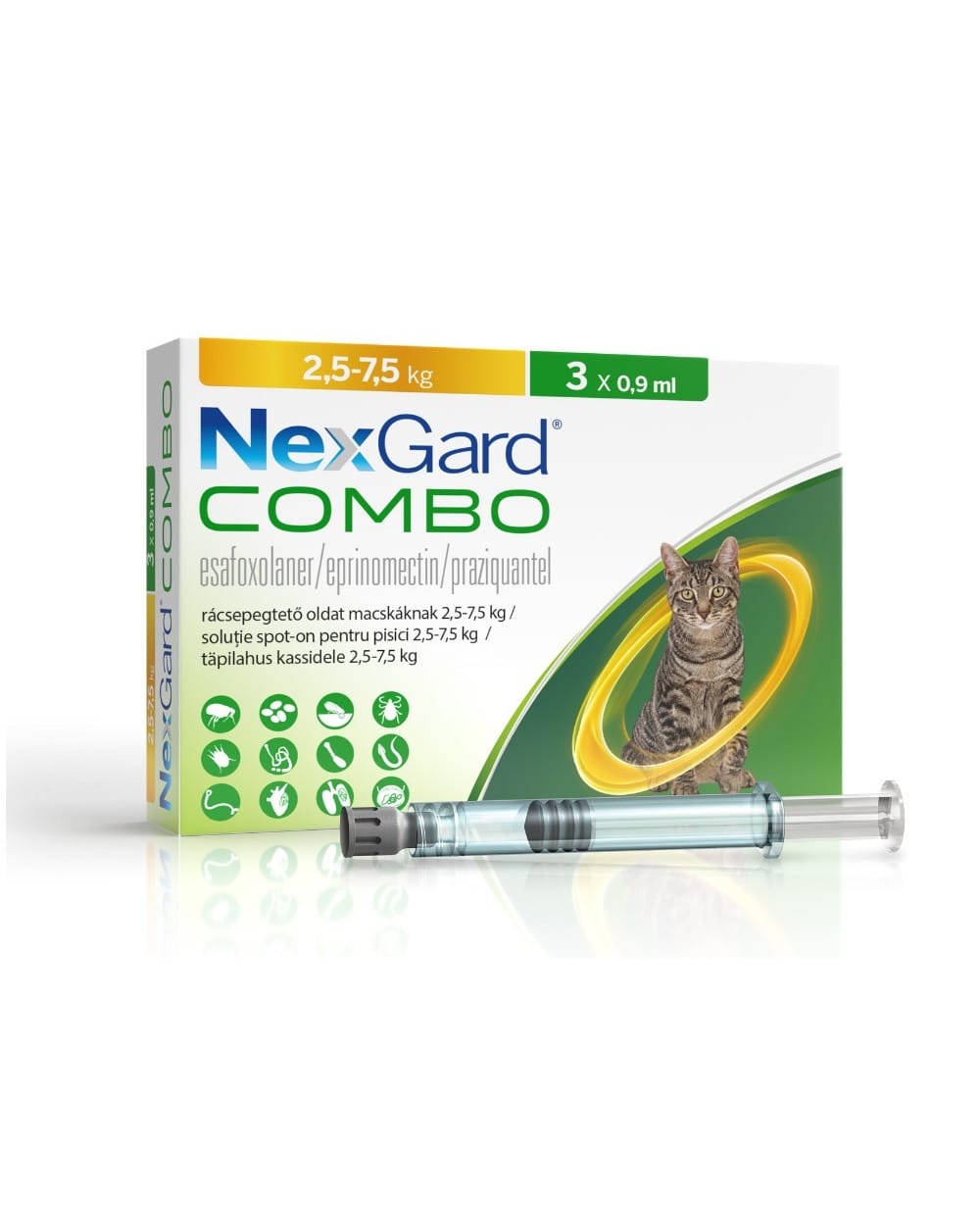
NextGard Combo For Cats 2,5-7,5kg – 3 Pippete
$62
9 people are viewing this product right now
🔥 8 items sold in last 3 hours
Hot Items
-

-
Original price was: $22.$19Current price is: $19.
-


Description
Active Substances
| NexGard Combo | Single Dose Volume (ml) | Esafoxolaner (mg) | Eprinomectin (mg) | Praziquantel (mg) |
|---|---|---|---|---|
| Cats 0.8–<2.5 kg | 0.3 | 3.60 | 1.20 | 24.90 |
| Cats 2.5–<7.5 kg | 0.9 | 10.80 | 3.60 | 74.70 |
Target species: Cats.
Therapeutic Indications
For cats with or at risk of mixed infections with cestodes, nematodes, and ectoparasites. This veterinary medicinal product is specifically indicated when all three parasite groups need to be treated simultaneously.
Ectoparasites
- Flea treatment (Ctenocephalides felis): A single treatment provides immediate and sustained flea-killing activity for 1 month. The product may be used as part of a treatment and control strategy for flea allergy dermatitis (FAD).
- Tick treatment: A single treatment provides immediate and sustained tick-killing activity against Ixodes scapularis for 1 month and Ixodes ricinus for 5 weeks.
- Ear mite treatment (Otodectes cynotis).
Gastrointestinal Cestodes
- Tapeworm treatment (Dipylidium caninum, Taenia taeniaeformis, Echinococcus multilocularis, Joyeuxiella pasqualei, and Joyeuxiella fuhrmanni).
Nematodes
Gastrointestinal nematodes
- Treatment of gastrointestinal nematode infestations (L3, L4 larvae and adults of Toxocara cati; L4 larvae and adults of Ancylostoma tubaeforme and Ancylostoma ceylanicum; adult forms of Toxascaris leonina and Ancylostoma braziliense).
Cardiopulmonary nematodes
- Prevention of heartworm disease (Dirofilaria immitis) for 1 month.
- Treatment of feline pulmonary nematode infestation (L4 larvae and adults of Troglostrongylus brevior).
Urinary nematodes
- Treatment of urinary nematode infestation (Capillaria plica).
Contraindications
Do not use in cases of hypersensitivity to the active substances or to any of the excipients.
Adverse Reactions
Increased salivation, diarrhoea, transient skin reactions at the application site (alopecia, pruritus), anorexia, lethargy, and vomiting have been rarely observed in clinical studies shortly after administration. These were predominantly mild, short-lived, and self-limiting.
The frequency of adverse reactions is defined by the following classification:
- Very common – more than 1 in 10 treated animals
- Common – more than 1 but fewer than 10 in 100 treated animals
- Uncommon – more than 1 but fewer than 10 in 1,000 treated animals
- Rare – more than 1 but fewer than 10 in 10,000 treated animals
- Very rare – fewer than 1 in 10,000 treated animals, including isolated reports
Dosage and Administration
Route of administration: Spot-on application.
Dosage
The recommended minimum doses are 1.44 mg esafoxolaner, 0.48 mg eprinomectin, and 10 mg praziquantel per 1 kg body weight. Select the appropriate applicator size based on the cat’s body weight.
| Cat Body Weight | Single Dose Volume (ml) | Esafoxolaner (mg) | Eprinomectin (mg) | Praziquantel (mg) |
|---|---|---|---|---|
| 0.8–<2.5 kg | 0.3 | 3.60 | 1.20 | 24.90 |
| 2.5–<7.5 kg | 0.9 | 10.80 | 3.60 | 74.70 |
| ≥7.5 kg | Appropriate combination of applicators | |||
Method of Application
- Use scissors to cut the blister along the dotted line, then pull off the cap.
- Remove the applicator from the packaging and hold it upright.
- Gently pull the plunger back, then twist and pull off the cap.
- Part the fur on the back of the animal at the base of the neck, in front of the shoulder blades, until the skin is visible.
- Place the tip of the applicator on the skin and apply the entire contents directly onto the skin in one spot. The product must be applied to dry skin in an area where the cat cannot lick it. For long-haired breeds, special care must be taken to ensure the product is applied to the skin and not the coat, to ensure optimal efficacy.
Treatment Schedule
For the treatment of flea and/or tick infestations and/or ear mites, combined with simultaneous treatment of gastrointestinal and/or pulmonary and/or urinary nematodes and cestodes, a single dose of the product should be applied. The need and frequency of treatment(s) should be determined in consultation with the responsible veterinarian, taking into account the local epidemiological situation and the animals’ lifestyle (i.e. outdoor access).
Areas free of heartworm (Dirofilaria immitis):
Cats not continuously at risk of heartworm infection should be treated according to the schedule prescribed by the veterinarian and adapted to each individual re-infestation situation. Otherwise, a narrower-spectrum product should be used to provide sustained treatment against the relevant parasites.
Heartworm-endemic areas:
Cats living in heartworm-endemic areas and identified as hunters may be treated at monthly intervals to provide appropriate prevention and treatment of potential cestode re-infestation. Otherwise, a narrower-spectrum product should be used for further treatment. Heartworm prophylaxis through elimination of Dirofilaria immitis larvae should begin within 1 month of the first expected exposure to mosquitoes and should continue for at least 1 month after the last mosquito exposure.
Ear mites:
For ear mites, a follow-up veterinary examination should be conducted 4 weeks after treatment to determine whether additional treatment with a narrower-spectrum product is necessary.
Storage Conditions
Store unused applicators in the original packaging to protect from light. Used applicators must be disposed of immediately.
You must be logged in to post a review.



Reviews
There are no reviews yet.