



Always Free Delivery
Email:sales@petshopboss.com
Worldwide delivery
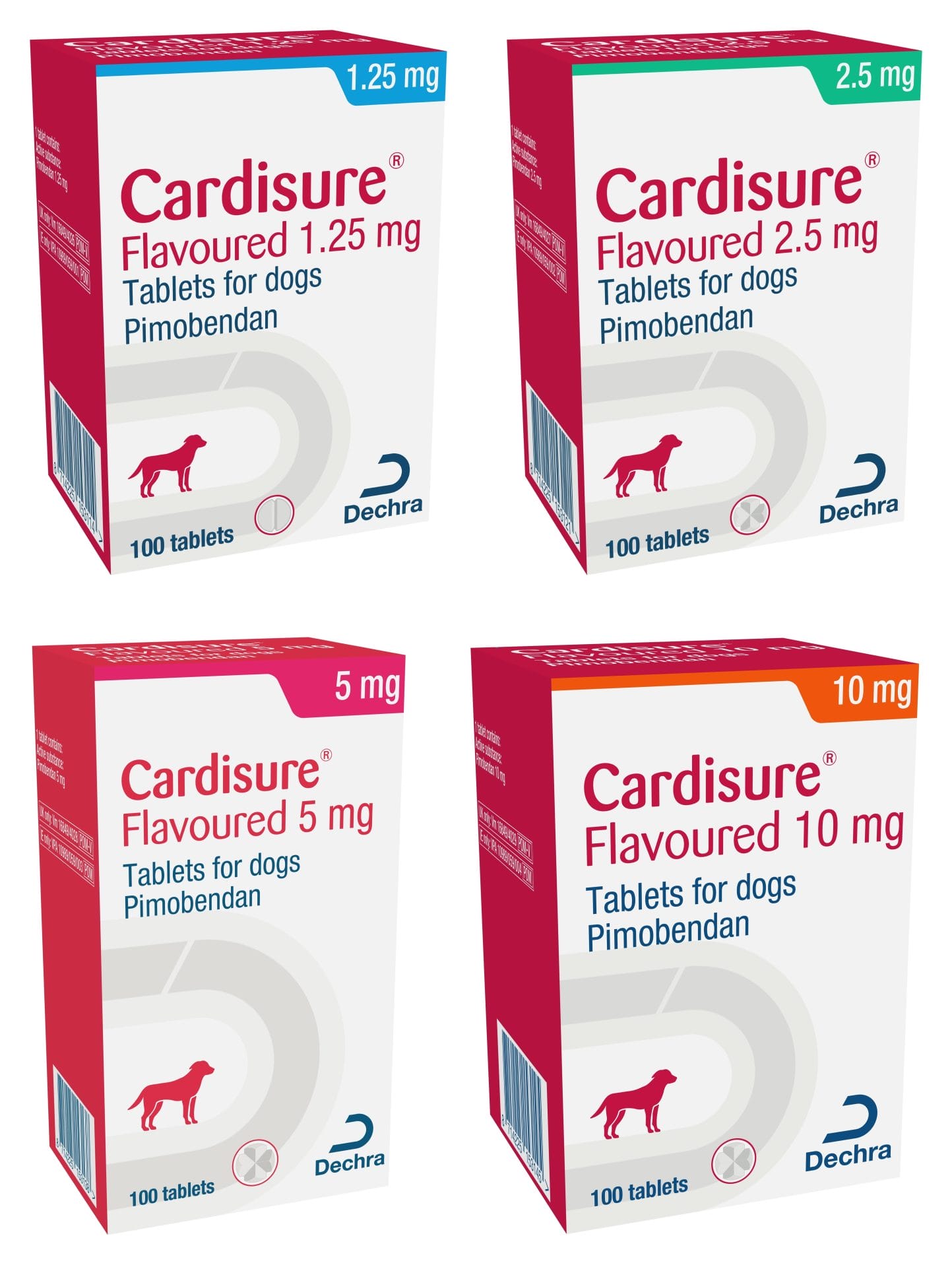
Cardisure / Pimobendan For Dogs 10 Tablets
Price range: $9 through $23
| ANIMALS | Dogs |
|---|---|
| ACTIVE INGREDIENT | Pimobendan |
| FORM | Tablets |
| Strength | 1.25mg, 2.5mg, 5mg, 10mg |
40 people are viewing this product right now
🔥 8 items sold in last 3 hours


Cardisure / Pimobendan For Dogs 10 Tablets
Please, note that the price is for 1 blister pack/10 tablets.
PHARMACEUTICAL FORM Tablet. Light brown round tablets are marked on one side and smooth on the other. The tablets can be divided into 2 equal parts. 4. CLINICAL DATA 4.1 Animal species for which the VMP is intended Dogs. 4.2 Therapeutic indications are defined for each animal species for treating dogs with congestive heart failure caused by valve deficiency (mitral and/or tricuspid valve regurgitation) or dilated cardiomyopathy. 4.3 Contraindications Do not use pimobendan in hypertrophic cardiomyopathies or diseases where an improved outcome for the heart disease cannot be achieved due to functional or anatomical reasons (e.g., aortic stenosis). Since pimobendan is mainly metabolized through the liver, it should not be administered to dogs with severely impaired liver function. See also point 4.7. 4.4 Special precautions for each target species None. 4.5 Special precautions for use Special precautions for animals during the use of the product Blood glucose should be regularly monitored during treatment in dogs with existing diabetes. Monitoring of cardiac function and morphology is recommended in animals treated with pimobendan. See also point 4.6. The tablets are flavored. The tablets should be stored in places inaccessible to animals to avoid accidental ingestion. Special precautions for people administering the veterinary medicinal product to animals In case of accidental ingestion, seek medical advice immediately, providing the leaflet or label of the product to the physician. Hands should be washed after using the product. Advice to physicians: Accidental ingestion, especially by a child, may lead to tachycardia, orthostatic hypotension, facial flushing, and headache. This product may cause cardiovascular adverse reactions upon accidental ingestion. 4.6 Adverse reactions (frequency and seriousness) A mild positive chronotropic effect (increase in heart rate) and vomiting may occur in rare cases. However, these reactions are dose-dependent and can be avoided by reducing the dose. Transient diarrhea, anorexia, or lethargy are observed in rare cases. Mitral valve regurgitation increases in rare cases during chronic therapy with pimobendan in dogs with mitral valve disease. Signs of effects on primary hemostasis (petechiae on mucous membranes, subcutaneous hemorrhages) may be observed during therapy in rare cases, although a clear connection with pimobendan has not been established. These signs disappear upon cessation of therapy. The frequency of adverse reactions is classified as follows:
- Very common (more than 1 in 10 treated animals showing adverse reactions)
- Common (more than 1 but less than 10 animals per 100 treated animals)
- Uncommon (more than 1 but less than 10 animals per 1,000 treated animals)
- Rare (more than 1 but less than 10 animals per 10,000 treated animals)
- Very rare (less than 1 animal per 10,000 treated animals, including isolated reports) 4.7 Use during pregnancy, lactation or egg laying Laboratory studies in rats and rabbits showed no evidence of teratogenicity or fetotoxicity. However, these studies have shown maternal toxicity and embryotoxicity at high doses, as well as demonstrating that pimobendan is excreted through milk. The safety of the veterinary medicinal product has not been evaluated in pregnant or lactating female dogs. It should only be used after the responsible veterinarian’s benefit/risk assessment. 4.8 Interaction with other veterinary medicinal products and other forms of interaction Pharmacological studies have not found interactions between the cardiac glycoside ouabain and pimobendan. The increase in heart contractility induced by pimobendan subsides in the presence of the calcium antagonist verapamil, diltiazem, and the β-antagonist propranolol. 4.9 Dosage and route of administration Do not exceed the recommended dose. Accurately determine body mass before therapy to ensure proper dosing. The tablets should be taken orally within a dose range of 0.2 mg to 0.6 mg pimobendan/kg body mass daily. The preferred daily dose is 0.5 mg pimobendan/kg body mass. The dose should be divided into two intakes (0.25 mg pimobendan/kg body mass each), one half of the dose in the morning and the other half approximately 12 hours later. Each dose should be given approximately one hour before feeding. The product can be combined with diuretic therapy, such as furosemide. To break the tablet with one mark into two halves, place the tablet on a flat surface with the marked side upward. While holding one half of the tablet down, press down on the other half. 4.10 Overdose (symptoms, emergency procedures, antidotes), if necessary Overdose may cause vomiting, a positive chronotropic effect, apathy, ataxia, heart murmurs, or hypotension. In this case, the dose should be reduced, and appropriate symptomatic treatment should be undertaken. During prolonged exposure (6 months) in healthy beagle dogs at doses 3- and 5 times higher than the recommended dose, thickening of the mitral valve and left ventricular hypertrophy were observed in some dogs. These changes have a pharmacodynamic origin. 4.11 Withdrawal period Not applicable
- PHARMACOLOGICAL PROPERTIES Pharmacotherapeutic group: cardiac stimulants excluding cardiac glycosides, phosphodiesterase inhibitors. Veterinary Anatomical Therapeutic Chemical Code: QC01CE90. 5.1 Pharmacodynamic properties Pimobendan, a benzimidazole-pyridazinone derivative, is a non-sympathomimetic, non-glycoside inotropic substance with potent vasodilatory properties. Pimobendan exerts its myocardial stimulating effect through two methods of action: it increases the calcium sensitivity of cardiac myofilaments and inhibits phosphodiesterase (type III). It also exhibits vasodilatory action by inhibiting the activity of phosphodiesterase III. When administered in cases of symptomatic valvular insufficiency along with furosemide, the product has proven to improve quality of life and extend life expectancy in treated dogs. When used in a limited number of cases with symptomatic dilated cardiomyopathy along with furosemide, enalapril, and digoxin, the veterinary medicinal product has proven to improve quality of life and extend life expectancy in treated dogs. 5.2 Pharmacokinetic properties Absorption After oral administration of this veterinary medicinal product, the absolute bioavailability of the active principle is 60-63%. Since the absolute bioavailability is significantly reduced when pimobendan is taken with food or shortly thereafter, the recommendation is for animals to be treated approximately 1 hour before feeding. Distribution The volume of distribution is 2.6 L/kg, which indicates that pimobendan is easily distributed in tissues. The average value of plasma protein binding is 93%. Metabolism The substance is demethylated through oxidation to its main active metabolite (UD-CG 212). Additional metabolic pathways are phase II conjugates of UD-CG-212, essentially glucuronides and sulfates. Elimination, The plasma elimination half-life of pimobendan, is 1.1 ± 0.7 hours. The main active metabolite is eliminated over a plasma elimination half-life of 1.5 ± 0.2 hours. Almost the entire dose is eliminated through feces
- PHARMACEUTICAL PARTICULARS 6.1 List of excipients Cellulose, microcrystalline (E460) Croscarmellose sodium Magnesium stearate Natural meat flavor 6.2 Major incompatibilities Not applicable. 6.3 Shelf life The Shelf life of the final veterinary medicinal product: 30 months. The shelf life of broken tablets after opening the primary packaging is 3 days. 6.4 Special precautions for storing the product Do not store at temperatures above 30 °C. Return broken tablets to the opened blister and use within 3 days.
You must be logged in to post a review.




Reviews
There are no reviews yet.